
The shipping industry is changing. Every year, new vessels are being built with cleaner engines, smarter systems, and better fuel options. But the truth is simple: most ships operating today were built long before decarbonization became a global priority. These older vessels will continue to make up a major proportion of the vessels on the sea for the coming decade.
This means the future of sustainable shipping does not depend only on new ships. It depends on what we do with the vessels already sailing today.
This is where vessel retrofitting for shipping comes in: updating, modifying, and improving existing ships so they use less fuel, operate more efficiently, and release fewer emissions. Retrofitting is now one of the most practical paths to a cleaner maritime industry because it lets ship owners extend the value of their fleet while meeting new regulations and environmental goals.
What is Retrofitting?
Retrofitting means modifying an existing vessel to improve its performance, efficiency, or compliance.
Instead of replacing the entire ship, specific systems are upgraded, such as engines, fuel systems, propulsion equipment, lubrication systems, or onboard energy controls.
You might have heard terms such as retrofitting existing vessels, ship retrofit, retrofit solutions or retrofit project in today’s maritime discussions. All of these refer to the same overall idea: Improving what we already have.
Retrofitting is especially important because existing vessels still make up the majority of the global fleet. If the maritime industry aims to reduce greenhouse gas emissions and reach sustainability goals, the existing fleet needs to evolve, not just the newbuilds.
This approach forms the foundation of ship decarbonization retrofit strategies worldwide.
Why Retrofitting Matters Today
There are three main reasons ship owners are prioritizing retrofitting:
1. Environmental Regulations Are Tightening
The International Maritime Organization has introduced stricter rules to reduce emissions, including:
-
CII (Carbon Intensity Indicator)
-
EEXI (Energy Efficiency Existing Ship Index)
-
MARPOL Annex VI fuel sulfur limits
To stay compliant, ships must operate more cleanly, and retrofitting makes that possible.
2. The Cost of Fuel is a Long-Term Burden
Fuel is one of the largest operating expenses for any vessel.
Retrofitting helps reduce fuel consumption, leading to savings that continue over time.
3. Sustainability Is Now a Business Expectation
Charterers, ports, and financial institutions are placing greater value on low-carbon vessels.
Modernizing an existing fleet also helps shipping companies remain competitive.
This combined approach supports retrofitting existing fleet marine efficiency across operations.
How Retrofitting Helps Improve Sustainability and Efficiency
Retrofitting helps improve:
| Focus Area | Benefit |
|---|---|
| Fuel Efficiency | Lower fuel use → lower operational cost |
| Environmental Performance | Reduced carbon emissions and better CII scores |
| Regulatory Compliance | Meets IMO and port state requirements |
| Operational Lifespan | Extends the useful life of vessels |
| Commercial Value | More attractive to charterers and cargo owners |
This is why ship decarbonization retrofit is increasingly considered a strategic approach, not just a technical fix.
Key Retrofitting Measures for Sustainability
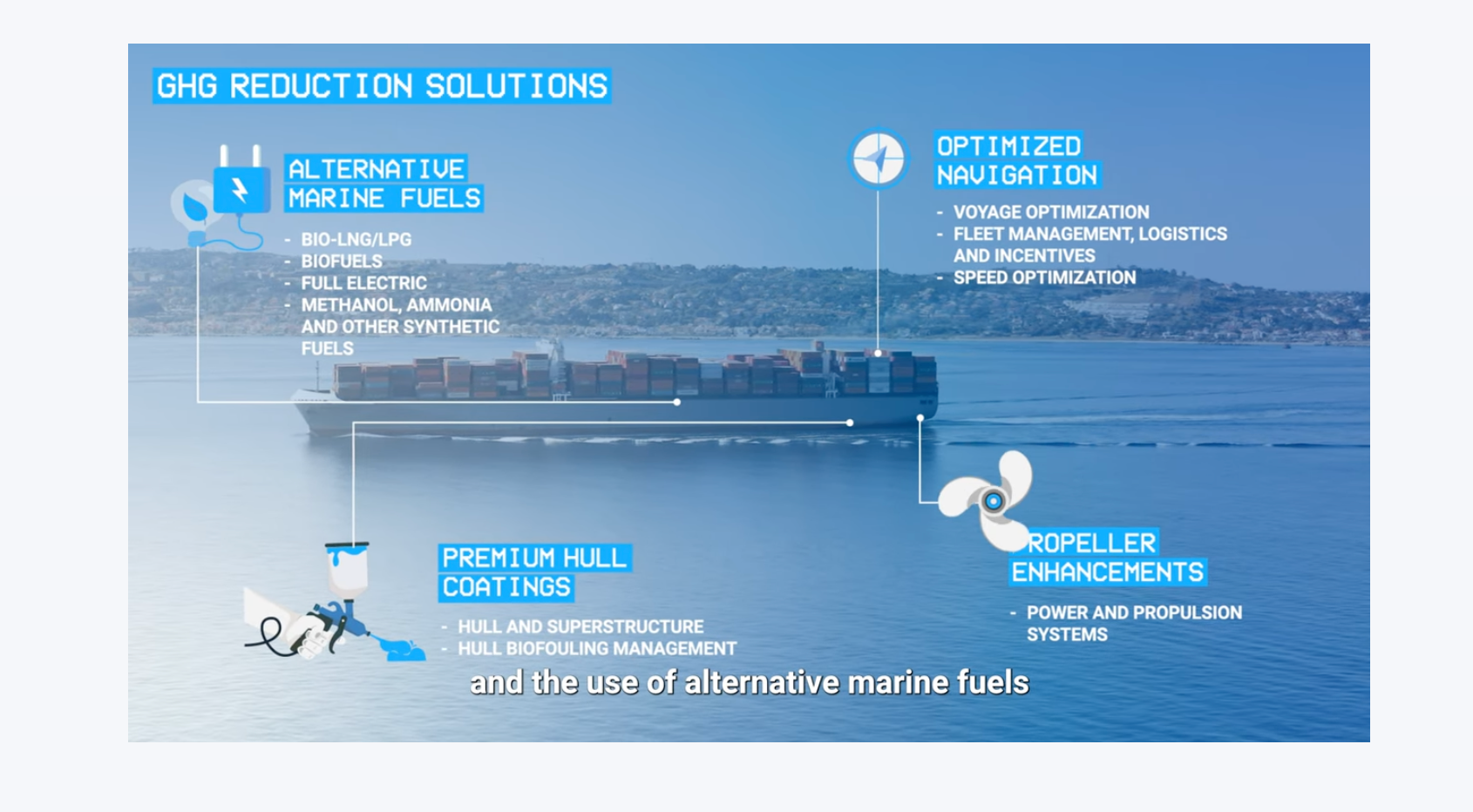
Image Source: Key GHG Reduction solutions given by the IMO in The IMO GHG Strategy 2023 Video
Here are some of the most effective ways to begin the retrofitting journey.
1. Switching to Alternative Fuels
Many ships currently rely on fossil fuels like heavy fuel oil or marine diesel.
Retrofitting allows ships to shift toward alternative fuels, like:
-
LNG
-
Green methanol
-
Ammonia
-
Biofuels
-
Future e-fuels
In some cases, dual-fuel engines or dual-fuel conversion can be used. These engines can operate on conventional marine fuels and a lower-carbon fuel, allowing flexibility as future fuels become more available.
This reduces carbon emissions and supports long-term sustainability.
2. Hybrid and Electric Propulsion
Modern hybrid systems combine electric motors with traditional engines.
This allows ships to:
-
Run quietly and efficiently during low-speed operations
-
Reduce fuel consumption over time
-
Improve manoeuvring efficiency in and out of port
Full electric propulsion may not be possible for large cruise ships, bulk carriers, or tankers today, but hybrid upgrades are already being used across the maritime industry.
This is one of the fastest-growing paths in vessel retrofitting in shipping today.
3. Shore Power and Port Electrification
When a vessel is at berth, onboard generators burn fuel to produce electricity.
Shore power systems allow ships to plug into clean electricity instead.
This reduces:
-
Fuel use in port
-
Noise levels
-
Exhaust emissions are released near coastal communities
More ports globally are preparing shore-side electrical infrastructure, meaning retrofit solutions for this will soon become more common.
4. Energy Saving Devices and Propulsion Upgrades
Improving vessel efficiency can be as simple as making propulsion smarter.
Some examples include:
-
Efficient propellers and more efficient propellers
-
Hull coatings to reduce drag
-
Air lubrication systems
-
Optimized rudder designs
Even small changes in propulsion can greatly improve performance, especially over long voyages.
5. Engine Upgrades and Performance Tuning
For older engines, both four-stroke engines and two-stroke engines, tuning and modifications can help:
-
Optimize combustion
-
Reduce methane slip (where applicable)
-
Improve reliability and operating conditions
This is often part of a ship decarbonization retrofit plan.
6. Fuel Handling and Storage Systems
If a ship transitions to low-carbon fuels, new fuel handling systems may be needed.
This includes:
-
Storage tanks
-
Fuel supply controls
-
Temperature and pressure monitoring
-
Safety arrangements
These modifications must align with the regulatory framework and shipboard space limits.
Carbon Emission Monitoring and Reporting
Modern systems can now track:
-
Fuel use
-
Voyage performance
-
Engine efficiency
-
Emissions in real time
Better data allows more accurate operational decisions and helps shipping companies reduce emissions while improving planning and reporting.
How Do We Know if a Ship is Retrofit-Ready?
Not every vessel can be retrofitted to the same level.
A retrofit project is most effective when:
-
The vessel still has a long operational life ahead (usually more than ten years)
-
The main engine and supporting systems are in reasonably good condition
-
There is room for modifications, such as tanks or additional energy storage
-
The operator is prepared for temporary downtime during dry docking
Sometimes, classification societies will assess what level of retrofitting is practical.
The goal is to ensure ship owners take a strategic approach, choosing upgrades that create value, not unnecessary cost.
Risks to Keep in Mind
Retrofitting delivers real benefits, but it must be planned carefully.
| Potential Risk | Why It Matters | How to Manage |
|---|---|---|
| High cost upfront | Some upgrades require investment | Evaluate lifecycle savings |
| Dry dock availability | Schedules can delay projects | Plan 12–18 months in advance |
| Fuel availability uncertainty | Some low-carbon fuels are still emerging | Choose flexible / dual-fuel pathways |
| Training requirements | Crew must be able to operate new systems | Provide onboard + simulator training |
The Future of Retrofitting

Decarbonization goals go beyond one system or one fuel.
Most shipping companies will adopt step-by-step upgrades, not overnight replacements.
The long-term path includes:
-
Smarter energy efficiency improvements
-
Wider use of alternative fuels
-
Continued development of zero-emissions propulsion systems
-
More support across the maritime sector for retrofitting knowledge sharing
Retrofitting is not just technical work; it is industry development.
Conclusion
Decarbonizing shipping is a shared responsibility; shore teams, crew, ship owners, ports, regulators, and the wider market all play a part.
New ships will shape the future. But existing ships will shape the future faster, because they are already here, already moving cargo, already connecting the world.
Through vessel retrofittin,g shipping, ship decarbonization retrofit, and a commitment to retrofit existing fleet marine efficiency, the maritime industry can move toward sustainability without leaving anyone behind.
The path to cleaner seas is not just about building new vessels.
It’s about improving the ones we already trust every day.
FAQs
1. Is retrofitting always cheaper than building a new vessel?
Not always, but retrofitting often allows ship owners to extend the life and value of a vessel at a lower cost than replacement.
2. How long does a retrofit take?
A typical retrofit may take several weeks to a few months, depending on the scope and dry docking schedule.
3. Will the crew need new training?
Yes. New fuel systems, dual fuel engines, and electric or hybrid operations require updated safety and operational training.
4. Does retrofitting guarantee compliance with future regulations?
No upgrade can guarantee future rules, but retrofitting increases readiness and flexibility.
5. What is the most effective first retrofit step?
In many cases, fuel efficiency improvements are achieved through propulsion upgrades, hull maintenance, and engine tuning.