
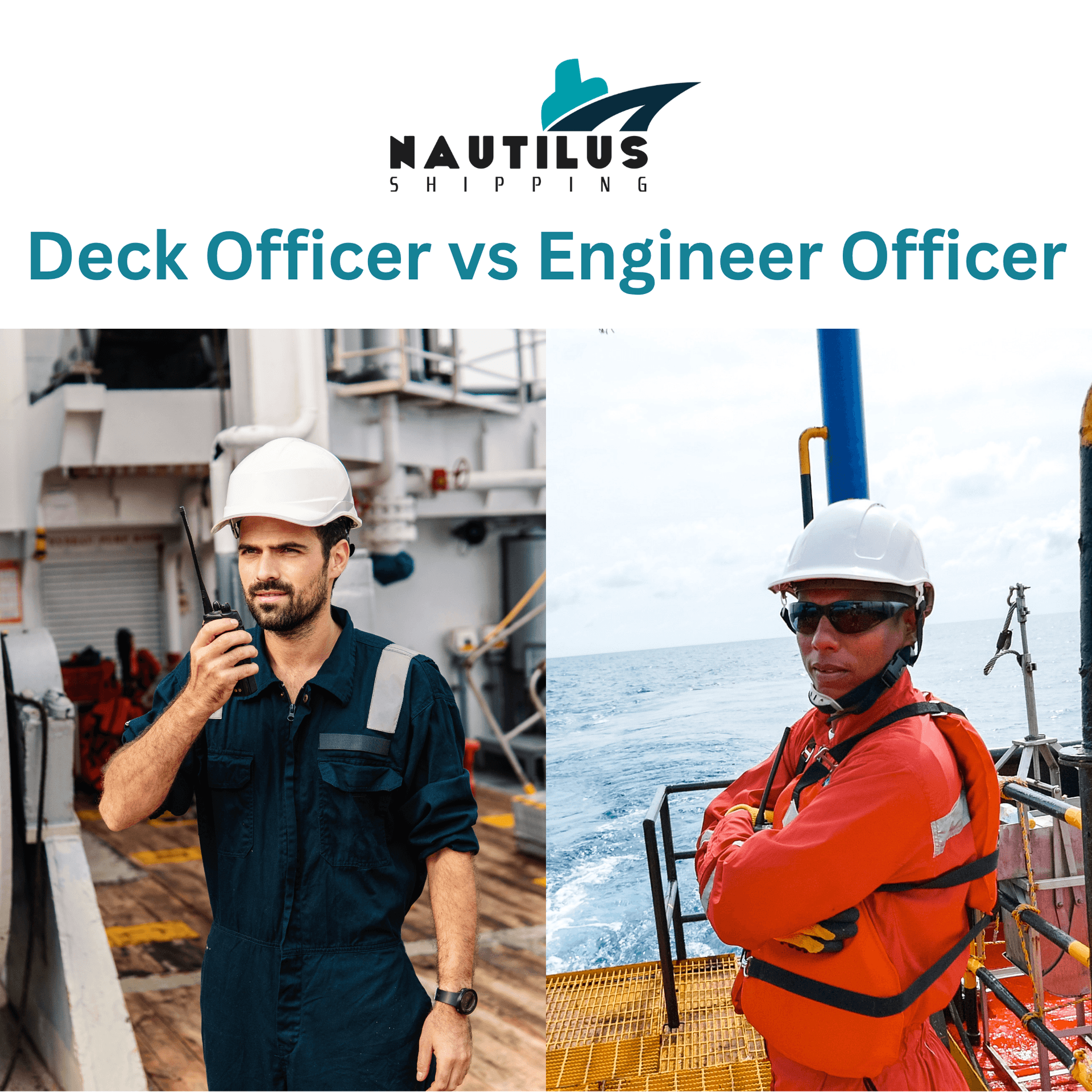
The discussion around deck officer vs engineer officer is common among aspiring seafarers and professionals in the maritime industry. While both roles offer rewarding careers at sea, the right choice depends on your interests as well as your ability to match those strengths to the role and decide based on your long-term goals. One focuses on navigation, cargo operations, and vessel command, while the other concentrates on machinery, power generation, and technical systems.
This guide explores the responsibilities, qualifications, daily routines, career progression, and key differences between these two essential maritime professions, along with the job opportunities each path can offer.
Understanding the Difference Between a Deck Officer and an Engineer Officer
Every commercial ship is broadly divided into two operational departments:
- The Deck Department
- The Engine Department
The Deck Department is responsible for navigation, cargo operations, communication, and the overall management of the vessel’s voyage. The Engine Department ensures that all propulsion, power generation, and machinery systems operate efficiently throughout the voyage.
Although their duties differ, both departments work closely together. A ship cannot operate safely without skilled Deck Officers and Engineering Officers supporting one another.
A Merchant Navy Deck Officer is responsible for navigating the vessel, managing cargo, ensuring compliance with maritime regulations, and supporting the safe operation of the ship.
Deck officers typically work on the bridge and the deck side of the vessel, making decisions that directly affect navigation and voyage safety.
Roles and Responsibilities
A Deck Officer performs a wide range of operational duties, including:
- Navigation and watchkeeping duties
- Voyage planning and route monitoring
- Monitoring radar, GPS, ECDIS, and navigational equipment
- Cargo handling and stowage control
- Supervising loading and unloading operations on cargo ships
- Conducting safety drills and emergency exercises
- Monitoring weather reports and sea conditions
- Ensuring compliance with maritime regulations
- Managing deck crew operations
- Overseeing mooring and anchoring activities
Deck Officers are ultimately responsible for ensuring the safe passage of the ship from one port to another.
Deck Department Career Progression
The typical progression in the Deck Department is:
- Deck Cadet
- Third Officer
- Second Officer
- Chief Officer
- Chief Mate
- Master (Captain)
The Captain or Master holds the highest command authority on board and carries overall responsibility for the vessel, crew, cargo, and passengers.
Required Qualifications for Deck Officers
Individuals interested in becoming a Merchant Navy Deck Officer typically pursue:
- Diploma in Nautical Science (DNS)
- B.Sc. Nautical Science
- Other approved maritime education programmes
Deck Officers require specialised training in:
- Navigation
- Cargo operations
- Maritime law
- Ship stability
- Meteorology
- Safety management
After academic studies, cadets complete sea-going training and certification requirements under STCW regulations before advancing through officer ranks.
Many officers also pursue internationally recognised qualifications such as the UK Certificate of Competency (UK CoC) to expand global career opportunities.
What Does a Typical Day Look Like?
Life as a Deck Officer revolves around watchkeeping and vessel operations.
A typical day may include:
- Standing navigational watch on the bridge
- Monitoring vessel traffic and radar systems
- Reviewing weather reports
- Conducting safety inspections
- Supervising cargo operations
- Coordinating with ports and pilots
- Managing crew assignments
- Participating in emergency drills
Unlike many shore-based careers, no two days at sea are identical. Weather conditions, traffic density, cargo operations, and voyage schedules all influence a Deck Officer’s daily responsibilities.
Career Growth
The career path for Deck Officers is well-defined and offers chances to advance into higher ranks. Experienced Deck Officers may also transition ashore into broader job options such as:
- Port operations
- Marine surveying
- Ship management
- Chartering
- Maritime training
- Logistics and shipping operations
While Deck Officers guide the ship, the Engineering Officer ensures the vessel has the power and technical capability to complete its voyage and operate safely wherever in the ocean it sails.
Engineering Officers work primarily in the engine room, where they manage propulsion systems, generators, pumps, and auxiliary machinery using the technical knowledge required to keep essential systems running reliably.
Without Engineering Officers, a ship simply cannot operate.
Roles and Responsibilities
An Engineering Officer is responsible for:
- Operating engines and generators
- Maintaining propulsion systems
- Managing power generation and distribution
- Monitoring auxiliary machinery
- Performing planned maintenance
- Diagnosing technical breakdowns
- Conducting repairs, troubleshooting and helping develop solutions to machinery problems
- Maintaining fuel and spare parts inventories
- Ensuring environmental compliance
- Supporting vessel operations through technical expertise
Engineering Officers begin at junior levels, where they learn ship machinery before taking on higher responsibilities.
Engineering Officers are also responsible for keeping critical systems operational during emergencies and providing technical support for vessel operations.
Engineering Department Career Progression
The usual career path includes:
- Engineer Cadet
- Fourth Engineer
- Third Engineer
- Second Engineer
- Chief Engineer
The Chief Engineer is the highest-ranking technical professional on board and oversees all machinery and engineering systems.
Required Qualifications for Engineering Officers
Engineering Officers generally follow a more technical educational route.
Common qualifications include:
- B.Tech Marine Engineering
- Marine Engineering Degree Programmes
- Mechanical Engineering pathways approved for maritime service
Marine engineering education covers:
- Thermodynamics
- Mechanical engineering
- Electrical systems
- Power generation
- Fluid mechanics
- Marine propulsion
- Automation and control systems
Most Engineering Officers complete a four-year marine engineering degree followed by mandatory sea-going training and certification.
Like Deck Officers, they may pursue internationally recognised qualifications such as the UK CoC.
What Does a Typical Day Look Like?
A typical day for an Engineering Officer centres around machinery performance and maintenance.
Daily activities may include:
- Monitoring engine performance
- Inspecting generators and pumps
- Running maintenance schedules
- Responding to equipment alarms
- Conducting repairs
- Managing fuel systems
- Checking power generation systems
- Updating technical records
- Supervising junior engineers
The work environment can be physically demanding, particularly in the engine room where heat, noise, and machinery are constant factors.
Career Growth
Experienced engineers often transition into shore-based careers such as:
- Ship management
- Power plants
- Manufacturing
- Marine consultancy
- Research and development
- Technical training
- Ship surveying
The transferable nature of marine engineering skills often creates diverse opportunities beyond the maritime sector.
Comparing the Two Careers
When discussing deck officer vs engineer officer, it is important to understand that both roles are equally important.
| Area | Deck Officer | Engineering Officer |
|---|---|---|
| Primary Focus | Navigation and cargo | Machinery and technical systems |
| Workplace | Bridge and deck | Engine room |
| Career Peak | Captain | Chief Engineer |
| Core Skills | Leadership, navigation, decision-making | Technical expertise, maintenance, and troubleshooting |
| Daily Focus | Vessel operations and watchkeeping | Machinery operation and repairs |
| Shore Opportunities | Ports, logistics, and ship management | Engineering, manufacturing, technical management |
Both professions require extensive training, commitment, and responsibility.
Choosing the Right Career for You
The decision ultimately depends on your interests, strengths and preferences.
A Deck Officer career may suit you if you enjoy:
- Navigation
- Leadership
- Decision-making
- Cargo operations
- Vessel command
An Engineering Officer career may suit you if you enjoy:
- Machinery
- Problem-solving
- Technical systems
- Maintenance and repairs
- Engineering challenges
Both career paths offer strong salary potential, global opportunities, professional growth, and the chance to work aboard modern marine vessels equipped with advanced systems and operating around the world.
Rather than asking which role is better, aspiring seafarers should focus on which environment and responsibilities align best with their interests and long-term career ambitions.
Conclusion
The debate around deck officer vs engineer officer has existed for decades within the Merchant Navy. The reality is that both professions are indispensable to a ship’s success.
A Deck Officer ensures safe navigation, cargo management, and operational leadership, while an Engineering Officer keeps the vessel powered, maintained, and technically sound.
Whether your interests lie on the bridge overseeing vessel operations or in the engine room managing complex systems, both careers offer rewarding opportunities, competitive salaries, and long-term growth within the global maritime industry.
FAQs
Is a Deck Officer better than an Engineering Officer?
No. Both roles are equally important and require specialised training, certification, and responsibility.
Who earns more: a Captain or a Chief Engineer?
Salaries are generally comparable and depend on vessel type, company, and experience.
Is marine engineering more technical than the Deck Department?
Yes. Engineering Officers focus heavily on machinery, power systems, repairs, and technical operations.
Can Deck Officers work ashore after sailing?
Yes. Many transition into ship management, ports, logistics, surveying, and maritime administration roles.
Which career has more shore-based opportunities?
Engineering Officers often have broader technical opportunities outside shipping, while Deck Officers move into specialised maritime management positions.
Do both careers require STCW certification?
Yes. Both Deck Officers and Engineering Officers must complete mandatory STCW training and certification requirements.
Which role is responsible for cargo handling?
Deck Officers oversee cargo handling, stowage planning, and cargo operations.
Who becomes the Captain of a ship?
Deck Officers progress through the ranks and may eventually become the Captain or Master of the vessel.