

The maritime industry is entering a turning point with regard to IMO’s GHG regulations. While technical teams, shipowners, and regulators have spoken about maritime decarbonization regulation for years, we are now seeing the first globally binding system that directly affects how ships operate and how voyages are planned and costed.
In April 2025, the International Maritime Organization (IMO) approved a policy framework that, for the first time, places a global price on emissions from international shipping. This includes IMO carbon pricing, new rules for fuel standards, and financial incentives for vessels that reduce emissions.
This change signals a long-term transition in how ships are powered, how fuel is selected, and how efficiency is measured. While new low-emission ships are being built, the existing global fleet still operates largely on conventional fuels, which means operational decisions and onboard practices will play a massive role in how each vessel adapts.
This blog breaks down what is changing, how it works, and what shipowners and crews should prepare for now.
Why Is Carbon Pricing Being Introduced in Shipping?
Shipping moves 90% of global trade, and because ships burn marine fuels, they release greenhouse gas emissions (GHG emissions). These maritime emissions are significant enough that the global shipping industry has been under pressure to combat climate change.
For years, progress has been uneven because shipping operates internationally. No single country regulates it, which is why it is crucial for IMO member states to work together. That is why the International Maritime Organization (IMO), through the Marine Environment Protection Committee, has now introduced a global carbon pricing mechanism.
This is the first carbon price applied to an entire industry sector worldwide.
And it signals one message clearly: Emissions will now have a measurable cost.
Reducing GHG Emissions from Ships: Why It Matters Now
With shipping being such a massive and crucial part of global trade, even incremental improvements in carbon intensity have a significant global impact. Today, GHG emissions from ships contribute to climate change, sea level rise, and increasing ocean temperature, conditions that directly affect the maritime environment we depend on.
Reducing emissions is a matter of operational resilience and long-term viability. Ports, financiers, charterers, and cargo owners are already prioritizing low-emission vessels. As global carbon pricing mechanisms expand, ships with higher emissions will face increasing commercial disadvantage.
In short, reducing GHG emissions protects the environment and protects the future competitiveness of every vessel and fleet.
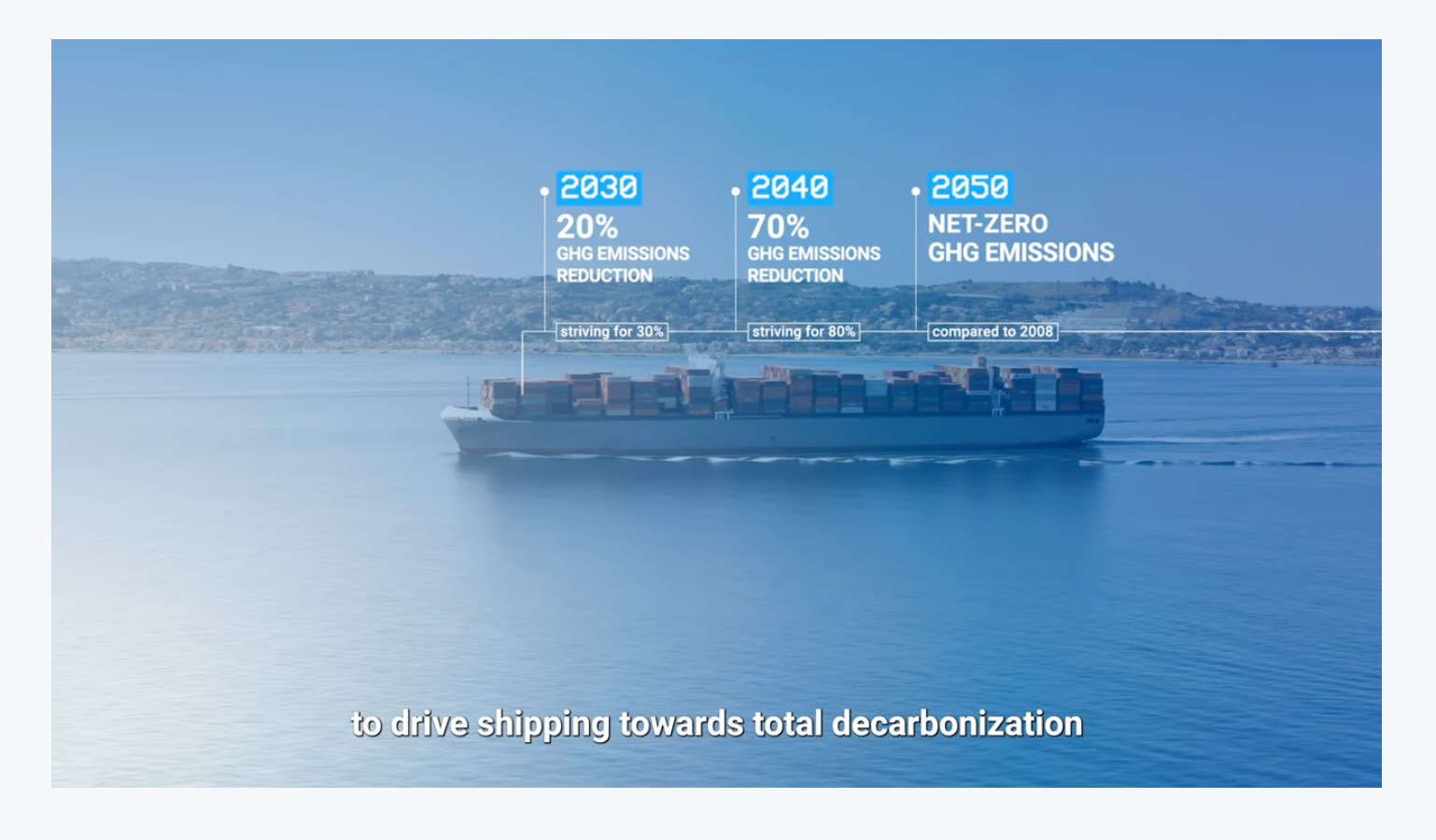
Image Source: Image of IMO’s global shipping decarbonization goals taken from IMO 2023 GHG Strategy Video
What Is Included in the IMO Net-Zero Framework?
The IMO Net-Zero Framework is built on two main components:
1. A Global Fuel Intensity Standard (GFI)
This measures how much greenhouse gas is emitted per unit of energy used by a vessel.
Lower GFI = Cleaner operation.
2. A Carbon Pricing and Credit Trading System
Ships that emit more than allowed will pay, and ships that emit less can earn and exchange credits.
This is where the financial mechanism comes in, and where shipowners need to understand the cost impacts.
Who Does It Apply To?
Beginning in 2027, the rules will apply to:
Ships over 5,000 GT: Which account for ~85–90% of emissions from international shipping
So, for most commercial cargo vessels, tankers, container ships, and large ocean-going ships, this will become mandatory.
Understanding the GFI Targets for Global Shipping
The IMO has set tiered reduction targets for how much ships must lower their GHG emissions intensity over time. These are designed to push the maritime transport sector toward net-zero emissions around 2050. The targets are under two tiers.
-
Tier 1 or Base Target:
| Year | Required Reduction |
|---|---|
| 2030 | 8% lower GFI |
| 2035 | 30% lower GFI |
| 2040 | 65% lower GFI |
Tier 2 or Direct Compliance Target, which calls for 21% lower GFI by 2030 and 43% lower GFI by 2035.
How the Carbon Pricing Mechanism Works
Under the new framework, every ship’s fuel use and voyage data will be compared to emissions limits set for its vessel category. This comparison determines whether the ship is performing above, below, or in line with GHG Fuel Intensity (GFI) targets.
Ships that perform better generate Surplus Units (SUs), which can be traded or saved. This effectively turns good environmental performance into a financial advantage. Meanwhile, vessels that exceed their allowed emissions must purchase Remedial Units (RUs) to balance out the excess. These RUs are priced differently based on how far the vessel is from its target, meaning unnecessary operational inefficiencies now directly translate into higher costs.
There are three outcomes:
1. Your vessel emits less than the target
-
You earn Surplus Units (SUs)
-
These can be traded or sold through the IMO registry
-
This rewards low-emission ships
2. Your vessel emits slightly above the target
-
If your ship meets the Tier I or base target but emits above the direct
compliance or Tier II target, you must purchase RUs at a lower rate of
$100 per tonne of CO₂-equivalent emissions.
3. Your vessel emits significantly above the target
-
You must buy Remedial Units at a higher price of $380 per tonne of CO₂-equivalent emissions
-
This acts as a strong financial penalty
This is what we refer to when we say carbon pricing and GHG pricing mechanism.
What are these Units?
Think of them as tokens representing emissions performance:
| Unit Type | When You Get It | What You Can Do With It |
|---|---|---|
| Surplus Units (SUs) | When your ship performs better than required | Exchange / trade / save them |
| Remedial Units (RUs) | When your ship emits above limits | Buy them to stay compliant |
The IMO Net-Zero Fund
According to IMO, the IMO Net-Zero Fund will be established for the collection of revenue from emissions. This will be used to:
-
Reward low-emission ships
-
Support innovation, research, infrastructure and just transition initiatives in developing countries;
-
Fund training, innovation and capacity building
-
Mitigate negative impacts on vulnerable States, such as Small Island Developing States and Least Developed Countries.
This is part of ensuring an equitable transition, so the entire industry sector progresses together.
What Does This Mean for Shipowners?
The shipowner’s cost of emissions will now influence commercial performance. Decisions around fuel type, routing, speed, maintenance, and data accuracy will impact both compliance and voyage profitability. Vessels that continue operating with inefficient fuel use or outdated practices may see a meaningful increase in operating expenses due to higher remedial unit purchases.
Conversely, owners who invest early in efficiency, whether through technical upgrades, clean fuels testing, or crew training, stand to gain a competitive edge. Some charterers and financiers already prefer vessels with stronger emissions profiles, and this trend will likely accelerate. Over time, emissions performance may influence chartering prioritization, access to insurance, and credit terms.
Early planning brings long-term commercial advantages.
What Does This Mean for Crew?
Crews directly influence how efficiently a vessel operates. Even with the latest systems, small operational habits such as engine load management, trim adjustment, auxiliary engine runtime, and adherence to planned speed can significantly impact carbon intensity and fuel usage.
This means seafarers will increasingly be asked to understand the emissions impact of daily tasks. Training will shift from simply following procedures to understanding why actions matter in terms of efficiency. Bridge and engine room teams may also handle more emissions reporting tools, and good data entry will be critical.
In short, operational awareness = cost control = regulatory compliance.
Crews are not just workers onboard, they are among the front line of decarbonization.
Will This Increase Shipping Costs?
Yes, for some. Specifically, the ships that do not comply with or exceed the limit of GHG Emissions. There will be cost implications for vessels that continue to operate with higher GHG fuel intensity. For these ships, the purchase of remedial units will raise voyage and operational expenditure.
However, the framework is also designed to reward efficiency. Vessels that demonstrate lower emissions intensity through improved operational practices, cleaner marine fuels, or technical upgrades can generate surplus units and reduce overall compliance costs.
The intention of this regulation is not to punish but to drive the sector toward lower-emission fuel pathways and more efficient vessel operation, aligning commercial performance with long-term decarbonization objectives.
It is meant to push the maritime sector toward cleaner marine fuels, low-carbon solutions, and better operational practices.
Practical Steps Shipowners and Crews Can Start Today
-
Improve Emissions Visibility
Use real-time monitoring and simplified dashboards to understand performance trends. -
Strengthen Voyage Planning Discipline
Speed management, hull condition awareness, and weather routing can reduce fuel waste. -
Invest in Crew Training
Knowledge of how daily practices impact GHG performance is now essential. -
Evaluate Fuel Pathways Early
Even partial adoption of lower-carbon marine fuels can reduce future exposure to pricing penalties. -
Enhance Maintenance Routines
A well-maintained engine and propeller system can significantly reduce excess fuel burn.
Smoother adaptation begins with small steps and consistent awareness, not rushed, expensive overhauls.
Conclusion
The introduction of IMO carbon pricing marks a new era in how vessels are operated, evaluated, and valued. It is not only a sustainability measure, but also a commercial framework that links emissions directly to cost and performance.
The outcome is clear: Operational excellence is now environmental excellence.
Shipowners who plan early will control costs. Crews who understand the emissions impact of daily actions will drive compliance. The companies that adapt now will be the companies that remain competitive in the years ahead.
The transition has started. The future belongs to prepared fleets.
FAQs
1. Does this apply to all vessels?
No. Only ships over 5,000 GT.
2. Do we need to switch to new fuels immediately?
Not immediately, but planning and testing pathways is essential.
3. Will carbon pricing make voyages more expensive?
It may, but efficient ships can offset cost through better operations and earning Surplus Units.
4. Does this replace the EU ETS and FuelEU Maritime?
No, this operates alongside regional rules.
5. What should ships start with first?
Measurement, data reliability, and crew awareness.