
India’s union budget announcements for FY 2026–27 include several measures focused on the maritime sector, particularly container manufacturing, inland waterways, and coastal shipping. In official statements, these steps are described as part of India’s economic transformation and an effort toward sustaining economic growth, with attention to logistics efficiency and greener freight movement.
In this blog, we look at the key proposals and figures that were shared, and what these measures could mean in practical terms for shipowners and seafarers across the industry.
Maritime Growth Focus: Union Budget 2026
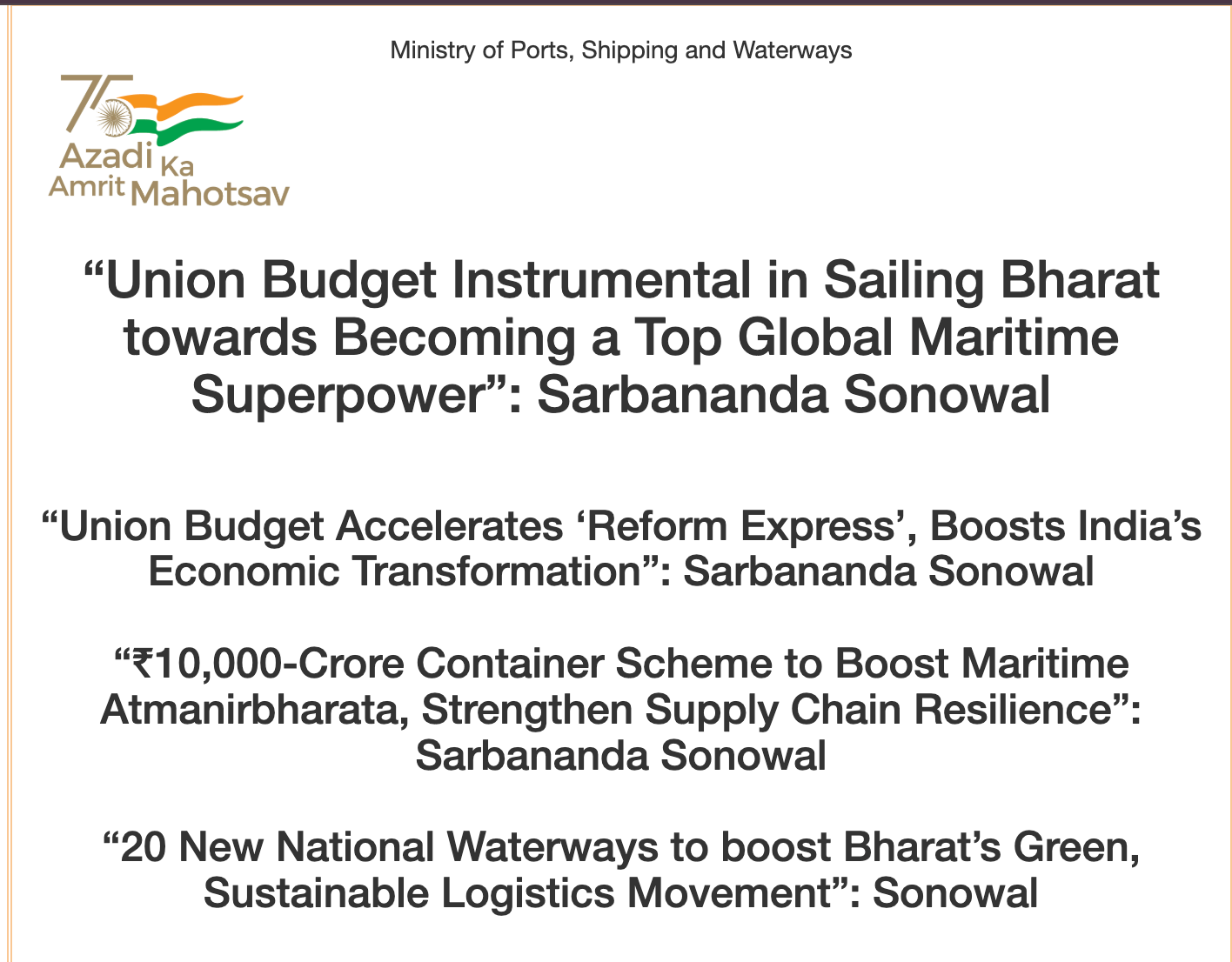
Gov Press Release from Ministry of Ports, Shipping and Waterways
In public comments, Union Minister Sarbananda Sonowal said the union budget instrumentally provides momentum to reforms and growth foundations, “positioning the maritime sector as the anchor” for the vision of Viksit Bharat, and that the maritime sector emerges as a strategic growth engine.
Announced measures include:
- A ₹10,000 crore container scheme
- Steps to operationalize 20 new waterways over five years
- A coastal cargo promotion scheme to encourage modal shift
- Ship repair facilities for inland water routes
Key features: new schemes and allocations
1) Container Manufacturing Assistance Scheme (CMAS): ₹10,000 crore over five years
A major announcement is the container manufacturing assistance scheme, described as a ₹10,000 crore outlay over five years to build a globally competitive container manufacturing ecosystem in India.
Key figures and stated targets include:
- India imports nearly two million units of empty containers yearly
- The scheme aims to significantly reduce India’s dependence on imported empty containers and to reduce import dependence over time.
- India aims to achieve an annual domestic manufacturing capacity of approximately one million TEUs over the next decade
- This program is expected to generate a total market value of nearly ₹1.07 lakh crore.
- This scheme is being projected to create around 3,000 direct jobs and more than 50,000 indirect jobs.
- The project will also directly support the growth of other industries such as corner castings, wooden frames, specialized steel, and water-based paints.
In the same context, Sonowal said the scheme is meant to build a strong domestic ecosystem capable of meeting rising demand and enhancing India’s competitiveness in global trade, and described it as part of India’s maritime growth journey and maritime self-reliance efforts, alongside the bharat container shipping line.
Why this is being emphasized: containers are central to global trade and international trade, and multiple statements link the scheme to reducing import dependence and strengthening national supply chain resilience.
2) National waterways: operationalizing 20 new routes in five years
The government plans to operationalize 20 new national waterways over the next five years.
Context provided in official statements includes:
- Only five national waterways existed prior to 2014, and the number has expanded to 111 waterways under the National Waterways Act.
- The movement of cargo through inland waterways increased from 18.1 million metric tonnes in 2014 to 145.5 million metric tonnes in 2024–25. This shows a growth of nearly 700%, with a compound annual growth rate of about 21%.
- Coastal length expanded from 2,716 km to more than 5,155 km, reducing the pressure on road and rail networks.
This is consistently framed as part of India’s inland waterways transformation and an effort to enable cost-effective cargo movement that is greener and reduces congestion.
3) Focused development of National Waterway–5 (NW-5) on the Mahanadi system
A specific project highlighted is the focused development of NW-5 in Odisha.
Stated details include:
- NW-5 will help with the connectivity of mineral-rich areas such as Talcher and Angul with major industrial centres and ports.
- Major terminals are planned at Kakudi, Kurunti, and Pankapal.
- Principal cargo: coal, coking coal, and limestone.
- Cargo potential is estimated to be:
- 10 million tonnes by 2032
- 20 million tonnes by 2047
Official commentary links this corridor to unlocking the economic potential of eastern India and strengthening India’s multimodal transport and sustainable growth strategy.
4) Coastal Cargo Promotion Scheme: pushing modal shift to water
The coastal cargo promotion scheme is described as an incentive-led push to shift freight from rail and road to water.
Reported goal:
- Increase the share of inland waterways and coastal shipping from 6% to 12% by 2047.
ETInfra notes this is the “second attempt” in the last three years to promote coastal and inland water-based transport, and references a 2023 Budget statement where coastal shipping promotion via PPP and viability gap funding “didn’t take off.”
Overall, the policy intent described is to support freight movement that is more energy efficient and helps reduce logistics costs, while improving port connectivity and multimodal integration.
5) Training and repair: capacity building for the inland waterways sector
The budget announcements also include capacity-building steps for the inland waterways sector:
- Training institutes are to be established as regional centres of excellence (RCoE), with training centres in Kolkata and Varanasi. The stated aim is to help youth across the entire waterway stretch to acquire specialised maritime and logistics skills.
- A dedicated ship repair ecosystem for inland routes is being planned at Varanasi and Patna.
- A Regional Centre of Excellence is also being developed in Dibrugarh, Assam.
6) Dedicated freight corridors and seaplane manufacturing (last-mile connectivity)
The official press release references:
- New Dedicated Freight Corridors connecting Dankuni (east) to Surat (west), aimed at improving port connectivity, cargo evacuation efficiency, and industrial logistics.
- Ensuring domestic manufacturing of seaplanes to improve last-mile connectivity and access to remote and island regions such as the Andaman & Nicobar Islands and Lakshadweep.
What this could mean for shipowners
This section stays within what has been stated, and frames implications as operational intent (not guaranteed outcomes).
Potential change in container availability and supply chain resilience
The container manufacturing plan is explicitly linked to reducing imported empty containers and improving maritime logistics reliability through a stronger domestic supply. If executed as described, it is intended to reduce foreign exchange outgo related to empty container imports and strengthen national supply chain resilience.
More viable coastal shipping and inland water transport as part of freight planning
The coastal cargo promotion scheme is designed to increase coastal and inland waterways share of freight. ETInfra also flags viability challenges that affected earlier attempts, and highlights that multimodal planning (first-mile/last-mile connections, lead times, and costs) matters for shifting cargo.
For shipowners and operators, this signals continued policy attention on coastal shipping, inland routes, and the connections between water transport and road/rail.
New corridors and NW-5 could influence regional cargo flows
NW-5 specifically targets a corridor connecting mineral belts and industrial centres to ports, with stated terminals and cargo categories. The budget framing positions it as a key pillar for cargo movement planning in eastern India.
What it could mean for seafarers
The most direct seafarer-facing elements in the available material are skills and employment ecosystem building:
Training pathways tied to inland water transport growth
The creation of RCoEs and training centers in Kolkata and Varanasi is explicitly intended to build specialized skills for the waterways workforce.
Repair ecosystem and local employment clusters
A dedicated repair ecosystem at Varanasi and Patna is framed as improving operational reliability while generating skilled employment.
These represent the Union Budget’s stated maritime priorities. Their wider implications, including potential shifts in employment patterns, skill requirements, workforce mobility, and operational standards, will become clearer as implementation advances.
The maritime vision behind these steps
Across statements and reporting, the policy narrative repeats a few themes:
- The maritime sector as an enabler of trade competitiveness and logistics efficiency
- A push for greener freight movement via inland routes and coastal shipping
- The longer-term goal of becoming a global maritime superpower / top global maritime superpower, in the words used in the official statement and headlines.
Conclusion
The Union Budget 2026 maritime announcements are concentrated around three levers: building domestic container manufacturing, expanding and professionalizing the inland waterways network, and making coastal shipping more attractive for domestic freight through incentives and supporting infrastructure.
The underlying stated intent is clear: strengthen logistics efficiency, support economic growth, and reduce pressure on road and rail networks, while building domestic capability (containers, training, repair).
FAQs
1. What is the Container Manufacturing Assistance Scheme?
The container manufacturing assistance scheme (CMAS) is a ₹10,000 crore outlay over five years intended to build a globally competitive container manufacturing ecosystem in India and reduce dependence on imported empty containers.
2. What is the target for annual domestic manufacturing capacity?
Official statements say India is targeting an annual domestic manufacturing capacity of about one million TEUs over the next decade (also reported as around 1 million 20-foot containers).
3. How many new national waterways are planned?
The government has said it will operationalize 20 new national waterways over the next five years.
4. What does “only five national waterways existed prior to” refer to?
Official statements say only five national waterways existed prior to 2014, and the network expanded to 111 waterways under the National Waterways Act.
5. What is the Coastal Cargo Promotion Scheme?
The coastal cargo promotion scheme is described as an incentive program to encourage shifting major cargo transportation from road and rail to waterways, with a goal of increasing inland waterways and coastal shipping share from 6% to 12% by 2047.
6. What is being announced for ship repair on inland routes?
According to the Press Information Bureau, a dedicated ship repair system is under planning and development for inland waterways is being planned at Varanasi and Patna, with the aim of improving operational reliability and generating jobs.
7. What is special about National Waterway–5?
NW-5 on the Mahanadi system is planned to connect Talcher/Angul with major industrial centers like Kalinga Nagar and ports at Paradeep and Dhamra, with terminals at Kakudi, Kurunti, and Pankapal and principal cargo including coal, coking coal, and limestone.
Sources:
- The Economic Times – Union Budget boosts India’s maritime ambitions
- ET Infra – Fresh push for coastal shipping and inland waterways
- Press Information Bureau (Govt. of India) – Union Budget 2026 maritime initiatives
- The Week – Maritime focus in Budget 2026
- The Economic Times – ₹10,000 crore for containers and waterways
- India Sea Trade News – ₹10,000 crore allocation for maritime infrastructure